
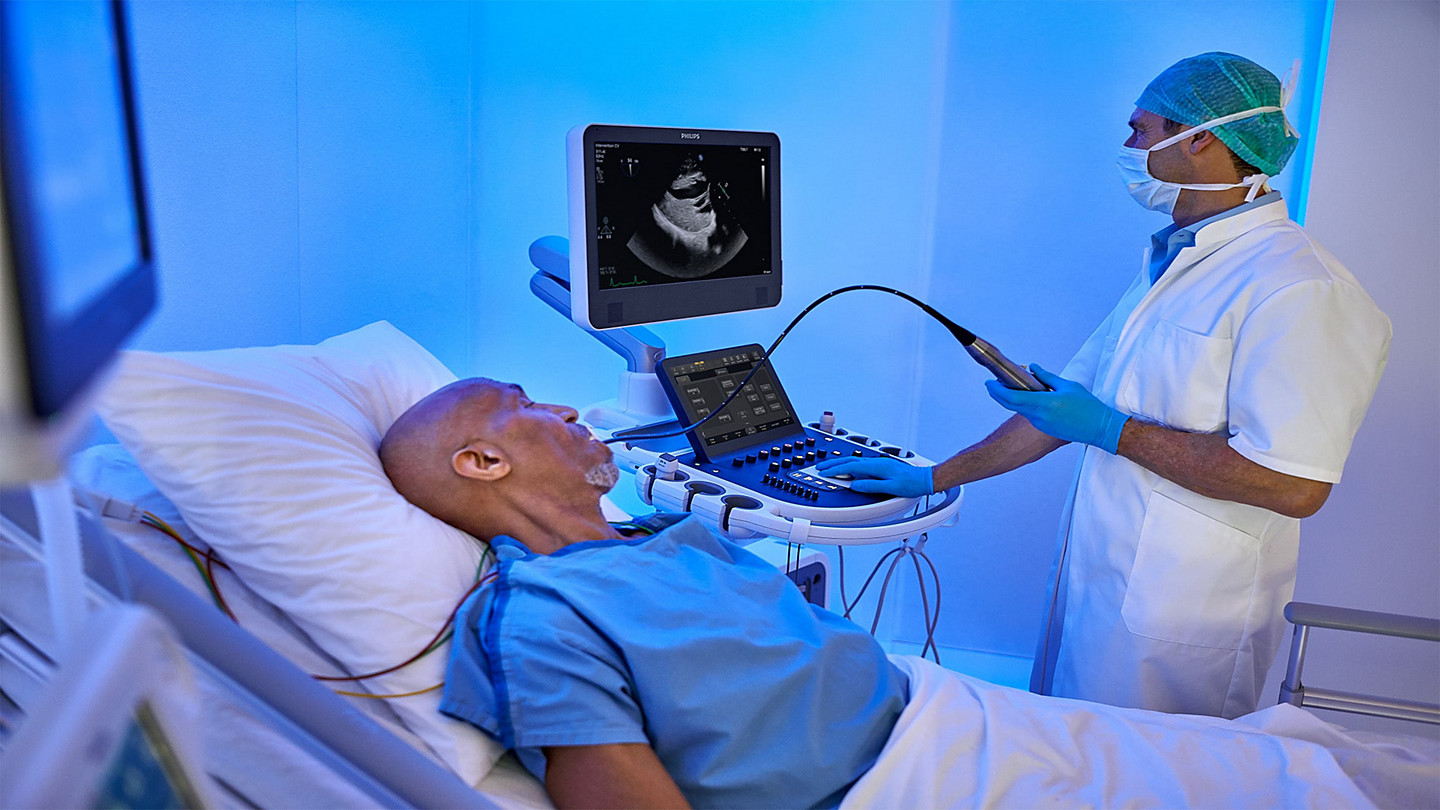
Photo: Philips. Original source · Philips editorial media library. Reproduced unchanged; No endorsement of AZNO implied.
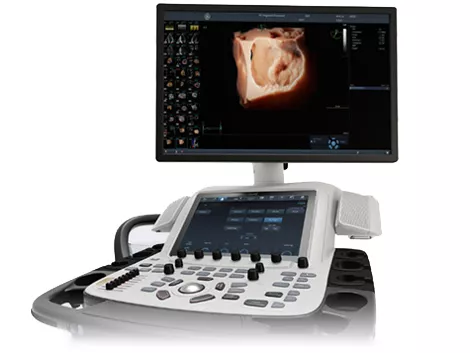
Photo: GE HealthCare. Original source · Used with permission. Reproduced unchanged; No endorsement of AZNO implied.
How AZNO compared these systems
AZNO Editorial checked manufacturer documentation for the exact systems, regulatory records for the 2026 additions and independent studies for evidence that could inform a purchasing decision. The conclusions below are our analysis of those records. The comparison is based on published evidence and does not include an AZNO hands-on test.
A published mitral-valve phantom study used both the EPIQ CVx and Vivid E95. The investigators reported comparable image quality for the velocity-time integral measurements in that setup. The experiment tested flow in a model, so its result applies to that measurement task. It provides no direct ranking of current software in routine adult, pediatric or interventional echo.
Which is better for your echo lab?
Start with Philips EPIQ CVx Transcend Plus if your priority is structural heart imaging in an existing Philips environment and the quote includes the required 3D TEE tools. Start with GE Vivid E95 Ultra Edition v206 if your lab already uses EchoPAC and relies on GE Automated Function Imaging (AFI), stress echo or serial strain follow-up. These are workflow-based shortlists. A purchase decision should follow a demo on the exact systems quoted.
As of November 10, 2026, Philips still highlights Transcend Plus for EPIQ CVx in its 2026 ASE material. The GE release verified here is E95 v206. GE introduced Vivid Pioneer as a separate system in 2025 and announced Explorer, Advanced and Focus in August 2026. Those launches and EchoPAC v211 do not establish upgrade eligibility for an E95. The scope is U.S.-referenced purchasing, with local availability and licenses to confirm. “Full option” means a quote that itemizes compatible probes, console licenses, workstation software and any separately required integration.
Adult TTE, 3D/4D TEE and image quality
Philips documents the X5-1c matrix probe for transthoracic echo (TTE), X8-2t for adult 3D transesophageal echo (TEE) and X11-4t mini TEE. Its EPIQ CVx examples show xPlane, TrueVue and MultiVue. GE documents the 4Vc-D matrix probe with cSound ADAPT, 6VT-D for adult 4D TEE and 9VT-D mini 4D TEE. GE’s Ultra Edition applications include HDlive and FlexiSlice Extend. Ask which probe and preset support each mode on the offered console.
The manufacturers demonstrate imaging features, but their examples do not establish which system gives better images in your lab. In a matched demo, have qualified users assess endocardial borders, difficult windows, color Doppler, volume rate and 3D/4D valve detail. Use comparable depth, sector width and acquisition settings, and time the work from acquisition through reviewed measurements.
Structural heart imaging and the 2026 DeviceGuide distinction
Philips highlights 3D Auto CFQ for mitral regurgitation volume and 3D Auto TV for tricuspid quantification. GE documents 4D Auto MVQ, AVQ and TVQ for mitral, aortic and tricuspid valve measurements, plus CT Fusion Live. These applications answer different questions. Ask the supplier to demonstrate the specific measurements, input images and reporting steps your team needs.
Philips showcased DeviceGuide in 2026. The FDA cleared EchoNavigator R5.0 on March 17, 2026, under K253614. EchoNavigator 5.0 requires a compatible Philips X-ray system and an EPIQ CVxi or CVx with the required CVxi functionality. The DeviceGuide tracking workflow requires X8-2t and a compatible mitral TEER device. X11-4t mini TEE is excluded from DeviceGuide tracking. If the cath lab needs this capability, request a separate integration quote and a compatibility statement for the complete installed setup.
What AI actually does on each system
On Philips, Smart View Select picks candidate LV views for analysis. AutoStrain assists with strain quantification, and 2D Auto EF Advanced supports both contrast and non-contrast images. 3D Auto CFQ and 3D Auto TV address specific valve measurements. Ask to see which functions open on the offered system, what input they require and where the operator reviews or corrects the result.
On GE, AI Auto Measure 2D assists with LV dimensions from parasternal long-axis views. Easy AutoEF estimates ejection fraction on supported adult TTE raw B-mode loops, while Easy AFI LV assists with strain and presents EF. GE also documents spectrum recognition and Cardiac Auto Doppler in the Vivid line. Demonstrate those tools on the exact E95 build and confirm how measurements transfer to your reporting software.
Rendering tools such as TrueVue and HDlive help display 3D or 4D anatomy. Evaluate them separately from view selection, segmentation and measurements. In the demo, record which tasks the operator can complete, how often contours or traces need correction and which results survive export.
Sources: Philips EPIQ CVx: on-cart AI and measurement tools · GE Vivid E Series: E95 application demonstrations
Strain, stress echo and offline review
Philips lists AutoStrain for LV, RV and LA, along with Smart View Select and 2D Auto EF Advanced. GE lists Easy AFI LV, AFI RV, AFI LA, Easy AutoEF, AFI Stress and Myocardial Work in its Vivid documentation. The ASE and EACVI consensus favors keeping the same strain software and release when possible for serial follow-up. In AZNO’s assessment, a lab with a large archive should give that continuity more weight than an extra automated feature. Before switching platforms, test how prior studies will be retrieved, reanalyzed and reported.
Compare Philips Ultrasound Workspace with GE EchoPAC on the specific release and licenses you will use. Confirm what runs on the console and what requires a workstation or plug-in. Ask both vendors to send a test study through your DICOM worklist, PACS and reporting workflow and check which clips, volumes and structured measurements remain usable after export.
What the 2026 guidance changes for a diagnostic echo lab
The British Society of Echocardiography’s 2026 AI statement covers acquisition, measurement, reporting and interpretation as distinct tasks. For a diagnostic lab, AZNO would judge a package by the quality of the acquired views, the ability to review and correct automated results, and the usability of the final report. Ask operators to run the same protocol and record the number of repeat acquisitions and manual corrections.
For a structural heart program, the ASE’s 2026 mitral TEER imaging guideline provides a way to define the exam tasks before comparing software. In a permitted test case, ask each vendor to demonstrate view changes, valve measurements and how procedural images reach the archive. An extra module matters only if it supports a task your team performs and your lab can run it on the quoted system.
Sources: British Society of Echocardiography 2026 position statement on AI · ASE 2026 mitral TEER imaging guideline
What sonographers report
In a July 2025 discussion, one sonographer who favored the Vivid E95 reported needing fewer image adjustments and reaching less often for measurement controls than on the Philips EPIQ they used. In a December 2021 discussion, a sonographer who mainly worked on Philips EPIQ liked AutoStrain on an updated unit but described more manual corrections on another. The posts are individual accounts and do not identify the exact Philips CVx release. The practical takeaway for a demo is to have your own operators complete the same image optimization and measurement tasks on both quoted systems.
Sources: Sonographer discussion on image optimization and control reach, July 2025 · Sonographer discussion on EPIQ software and AutoStrain, December 2021
Full-package prices with 2D and 3D TEE
The November 2026 price benchmarks supplied to AZNO Editorial are USD 75,000 for a full-option Philips EPIQ CVx package and approximately USD 82,000 for a full-option GE Vivid E95 package. Each price is described as including a dedicated 2D TEE probe and a 3D/4D TEE probe. The indicated GE premium is about USD 7,000, or 9% relative to the Philips figure.
These are editorial reference figures provided to AZNO. The seller, unit condition, exact probe model numbers, installed licenses, warranty and treatment of tax, shipping and installation were not independently verified. Ask for written quotes with the same scope. In AZNO’s view, the lower Philips figure is a starting point for a price comparison. The GE premium is easier to justify if its installed workflow saves retraining or preserves access to historical EchoPAC studies and measurements.
What to demand in a full-option quote
Request the console model, serial number, installed software build and screenshots of enabled licenses. Itemize the TTE and TEE probes by model, part number and condition. For used or refurbished equipment, ask for dated probe test records and, where applicable, documented TEE inspection, electrical safety testing and reprocessing instructions for the exact probe.
Ask the supplier to confirm local service, parts and software support in writing and check any field corrections against the exact console and probes. Compare itemized costs for hardware, probes, licenses, workstation seats, integration, training, warranty and support over the same term. Use matched written quotes to test the price benchmarks above.
Comparison at a glance
| Buying criterion | Philips EPIQ CVx Transcend Plus | GE Vivid E95 Ultra Edition v206 |
|---|---|---|
| Console display | Philips lists multiple display options, including a 24-inch LCD Pro | GE lists a 23.8-inch HDU monitor for the Vivid E Series |
| Matrix TTE | X5-1c with xMatrix imaging | 4Vc-D with cSound ADAPT |
| Adult and mini TEE | X8-2t and X11-4t | 6VT-D and 9VT-D |
| AI-assisted routine measurements | Smart View Select and 2D Auto EF Advanced | AI Auto Measure 2D and Easy AutoEF |
| Function and strain | AutoStrain LV/RV/LA, Smart View Select, 2D Auto EF Advanced | Easy AFI LV, AFI RV/LA, Easy AutoEF, AFI Stress, Myocardial Work |
| Valve tools | TrueVue, MultiVue, 3D Auto CFQ, 3D Auto TV | HDlive, FlexiSlice Extend, 4D Auto MVQ/AVQ/TVQ |
| Interventional integration | EchoNavigator and DeviceGuide require a compatible system and separate configuration | CT Fusion Live on supported, licensed setups |
| Offline analysis | Ultrasound Workspace, with version and modules confirmed | EchoPAC Software Only or Plug-in, with version and modules confirmed |
| Full package with 2D and 3D/4D TEE | USD 75,000 benchmark | Approximately USD 82,000 benchmark |
This table compares documented capabilities. Ask each supplier to confirm the active license, compatible probes and regional availability for every required option.
Sources and further reading
- Independent mitral-valve phantom study using EPIQ CVx and Vivid E95
- ASE and EACVI consensus on strain echocardiography and serial measurements
- FDA clearance record for EchoNavigator R5.0, March 2026
- GE HealthCare August 2026 Vivid portfolio announcement
- Philips EPIQ CVx product page and official system images
- Philips at ASE 2026: Transcend Plus and cardiovascular ultrasound
- Philips Transcend Plus release announcement
- Philips EchoNavigator Release 5.0 instructions and DeviceGuide compatibility
- Philips Ultrasound Workspace technical specification
- GE HealthCare Vivid E95 Ultra Edition and official system images
- GE HealthCare Vivid E Series clinical applications and EchoPAC
- GE HealthCare Vivid E95 technical specifications and probe list
- GE HealthCare Vivid Ultra Edition clinical applications guide
- AccessGUDID: GE Vivid E95 v206 device record
- GE HealthCare Vivid Pioneer launch and comparison with E95 v206
Use current manufacturer instructions and qualified technical advice for your exact equipment. This article does not establish clinical suitability, guaranteed repair results or an AZNO offer.