
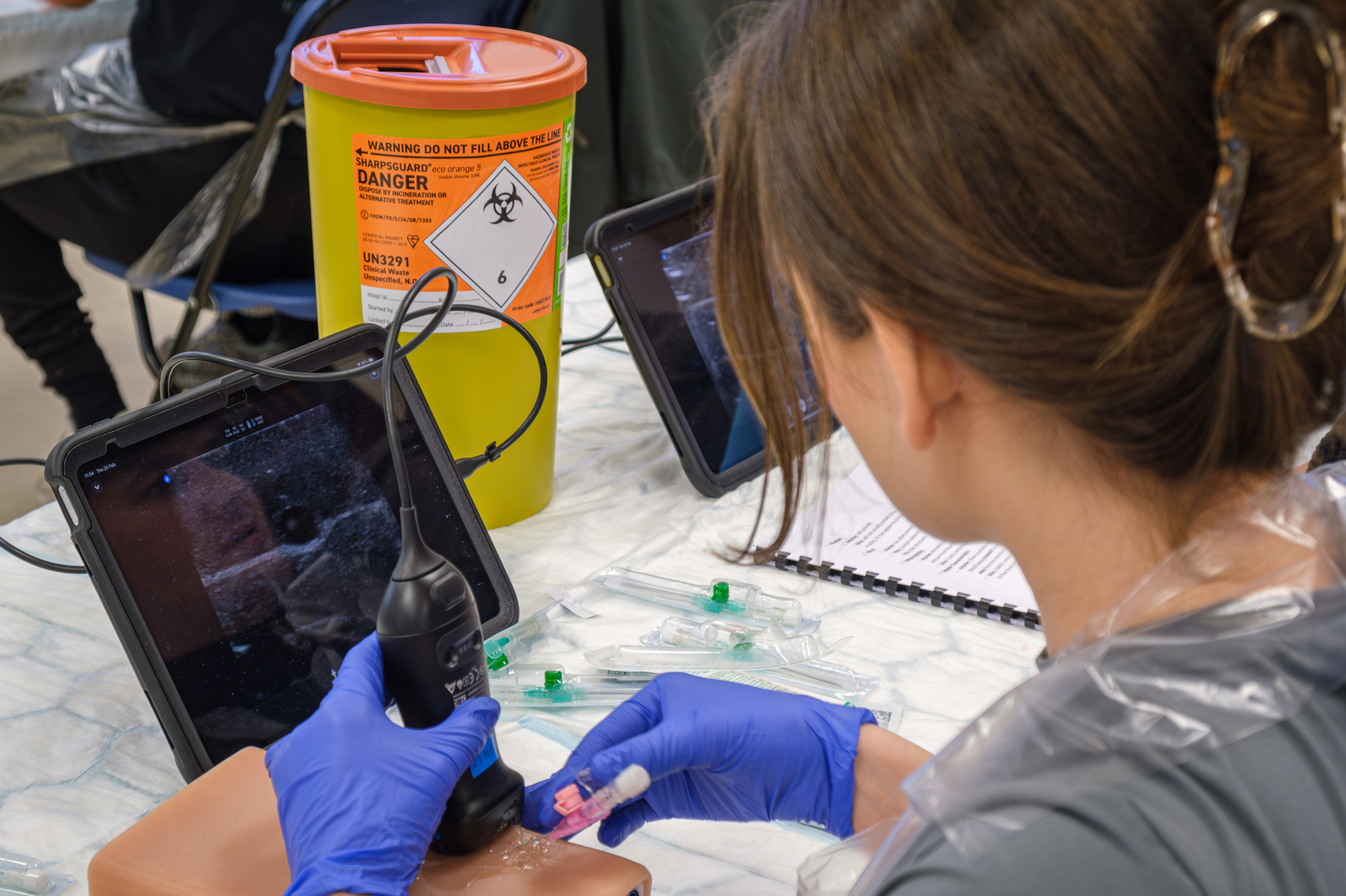
Edward Finch, Jun Jie Lim, Samuel Birks, Ansaam El-Sherif, Stephen Cross, Jamie Sterland and Deborah Clark; University Photography team; The Clinical Teacher, Figure 1, DOI 10.1111/tct.70320 Original source · CC BY 4.0. Reproduced unchanged; No endorsement of AZNO implied.
Same method for every handheld review · Rubric v2
How we score Butterfly iQ3
AZNO's editorial feature-and-portability score is 8.7/10, with 100% assessed rubric coverage. It describes the named configuration, not clinical image quality, diagnostic accuracy, reliability or value for money.
| Criterion | Weight | Grade / 10 | Weighted points | Evidence for this configuration |
|---|---|---|---|---|
| Supplied imaging formats | 20% | 10.0 | 2.00 | Linear, convex and phased formats on one scanner. Manufacturer source |
| Imaging and Doppler functions | 25% | 8.0 | 2.00 | B, M, color, power and PW with the specified Advanced entitlement. Manufacturer source |
| Processing and smart tools | 20% | 10.0 | 2.00 | Advanced includes Auto Bladder/Auto B-Lines and imaging tools; country/version restrictions apply. Manufacturer source |
| Indicative scanning runtime | 20% | 8.0 | 1.60 | Up to two hours: a manufacturer maximum, not guaranteed continuous runtime. Manufacturer source |
| Probe-only weight | 15% | 7.0 | 1.05 | 300 g probe; host and charger excluded. Manufacturer source |
| Final editorial score | 8.7/10 | 100% assessed coverage · round only the final result | ||
Calculation, not a mystery number
Score = sum of assessed weighted points ÷ assessed weight. For this review: 8.65 ÷ 1.00 = 8.7/10 after final rounding. Missing criteria receive neither zero nor an invented neutral grade; they are excluded and the coverage is disclosed.
Shared grading anchors
The same five weights and thresholds apply to all ten reviews. A higher feature score is not automatically the right device for a specialist's workflow.
- Supplied imaging formats · 20%
- 5: one format; 8: two; 10: linear, convex and phased. Optional unpurchased heads do not count. A focused specialist is not necessarily a worse purchase.
- Imaging and Doppler functions · 25%
- 6: documented B/2D, M and color; 8: those functions plus PW; 10: PW plus CW/TDI. Unverified kit entitlements remain unassessed. This measures function breadth, not image quality.
- Processing and smart tools · 20%
- 7: documented harmonic, compound or advanced image processing; 10: documented automated measurement or guidance in the reviewed entitlement. Unknown tools are unassessed, not absent. This does not score algorithm accuracy.
- Indicative scanning runtime · 20%
- 5: below 60 min; 6: 60–89; 7: 90–119; 8: 120–179; 9: 180–239; 10: 240+ min. Use the conservative end of a range; an up-to figure remains a maximum. Host-powered and probe-powered scenarios are not equivalent tests.
- Probe-only weight · 15%
- 10: ≤150 g; 9: >150–200; 8: >200–250; 7: >250–300; 6: >300–350; 5: >350–400; 4: >400 g. Do not substitute display/system weight for probe-only weight.
How to compare: match intended examinations, included probes, software entitlement and host first. Compare ready-to-scan package cost separately. Runtime claims use different workloads; probe-only weight excludes displays/accessories. Small numerical differences are not demonstrated clinical performance differences.
Unified on October 13, 2026: this shared rubric replaces the two earlier batch methods. Recalculated totals may differ from earlier versions. Prices, customer anecdotes and unverified electrical draw do not enter the numerical score.
One probe, several imaging formats
The Butterfly iQ3 buying proposition is a single handheld probe used across different point-of-care questions. That convenience matters when carrying separate transducers would be impractical. It does not establish that the same probe geometry is ideal for every examination, so a meaningful iQ3 review needs to connect versatility with the tasks you actually perform.
Documented specifications
Butterfly lists 1–12 MHz operation with linear, convex and phased imaging formats. Confirm the exact enabled imaging tools, approved host and regional plan/version before purchase.
Sources: Butterfly: iQ3 technical specifications · Butterfly: iQ3 product page and availability notes
Positive social-media comments
Positive comments: Reddit u/Maveric1984 explicitly reports upgrading to iQ3 and praises improved images, rapid connection and replaceable cabling. This is a self-reported experience, not a controlled test.
Sources: Reddit r/emergencymedicine: handheld ultrasound · Reddit r/emergencymedicine: handheld-device comparison
Negative social-media comments
Negative comments: Reddit u/reynardine_fox finds the iQ3 footprint too wide for some cardiac views and prefers a narrower linear footprint for certain procedures, despite praising its workflow features.
Sources: Reddit r/emergencymedicine: handheld ultrasound · Reddit r/emergencymedicine: handheld-device comparison
Feedback context and limitations
The linked discussions contain different generations. Complaints about original iQ or iQ+ are not iQ3 findings. User expertise, affiliations and exact hosts are unverified; assess the acoustic windows and handling relevant to your own work.
Sources: Reddit r/emergencymedicine: handheld ultrasound · Reddit r/emergencymedicine: handheld-device comparison
Disadvantages, limitations and tradeoffs
Documented/structural tradeoffs: a 300 g probe and a wired host connection may not suit every handling preference. The specification lists a non-replaceable battery, making its service/replacement arrangements important to ownership planning.
Community and commercial tradeoffs: some iQ3 comments raise footprint concerns for certain cardiac windows. Advanced software availability depends on country, plan and version; verify entitlements and ongoing costs. Neither issue establishes universal poor image quality.
Sources: Butterfly: iQ3 technical specifications · Butterfly: iQ3 product page and availability notes
Buying value and software access
Treat the probe quote and the software entitlement as one purchasing decision. Request a list of included imaging tools, storage/export functions, integration options and any ongoing charges for the exact plan. Do not carry a 2024 forum subscription price into a 2026 purchase comparison. Nor should advertised battery maxima be compared directly with another manufacturer's result using a different workload.
AZNO takeaway: iQ3 is a candidate when one-probe versatility is a high priority. Its buying value depends on whether the probe shape and entitled features match your examinations and whether the complete ownership cost is acceptable. This review does not assign a numeric image-quality score or claim that AZNO tested the device.
Sources: Butterfly: iQ3 technical specifications · Butterfly: iQ3 product page and availability notes
Approximate price and what it covers
Approximately US$3,899 hardware; required software priced separately
Butterfly's US individual pricing lists iQ3 hardware at US$3,899. Core is $299/year; Advanced is $420/year or $1,500 one-time with five years of guaranteed software access.
The reviewed feature configuration assumes the Advanced imaging/automated tools are enabled, not Core alone. Calculated initial hardware-plus-software totals are $4,198 with Core, $4,319 with annual Advanced, or $5,399 with one-time Advanced, before host, tax and other unverified charges. Organizational and regional offers may differ.
Price check: October 13, 2026. Published prices can change; ask for a current, itemized local offer.
Comparison at a glance
| Criterion | Documented information | Source |
|---|---|---|
| Probe weight | 300 g; host device and charger are separate. | Butterfly: iQ3 technical specifications |
| Technology profile | CMUT-based Ultrasound-on-Chip with linear, convex and phased imaging formats; Biplane and other tools are documented but their entitlement is region/plan/version-specific. | Butterfly: iQ3 product page and availability notes |
| Battery capacity | 2220 mAh lithium-ion; manufacturer lists the battery as non-replaceable. | Butterfly: iQ3 technical specifications |
| Runtime | Up to two hours, a manufacturer maximum rather than a guaranteed shift duration. | Butterfly: iQ3 technical specifications |
| Charging | 10–90% in 90 minutes; do not compare it with a competitor's 0–90% result as if the tests were identical. | Butterfly: iQ3 technical specifications |
| Electrical consumption | Typical operating draw in watts not verified. No wattage ranking is inferred from capacity or maximum runtime. | Butterfly: iQ3 technical specifications |
Runtime tests are not directly comparable. Wired systems draw from the host/power accessories. Unknown typical watts remain unknown; capacity and output ratings are not measured consumption.
Sources and further reading
- Butterfly: iQ3 technical specifications
- Butterfly: iQ3 product page and availability notes
- Reddit r/emergencymedicine: handheld ultrasound (November 1, 2024 upgrade comment) — Self-reported upgrade; older-generation comments excluded from iQ3 findings
- Reddit r/emergencymedicine: handheld-device comparison (Earlier discussion; UI displays relative ages) — Subjective image/footprint comparisons, identities and affiliations unverified, historical prices excluded
- Butterfly official pricing/configuration
Use current manufacturer instructions and qualified technical advice for your exact equipment. This article does not establish clinical suitability, guaranteed repair results or an AZNO offer.