
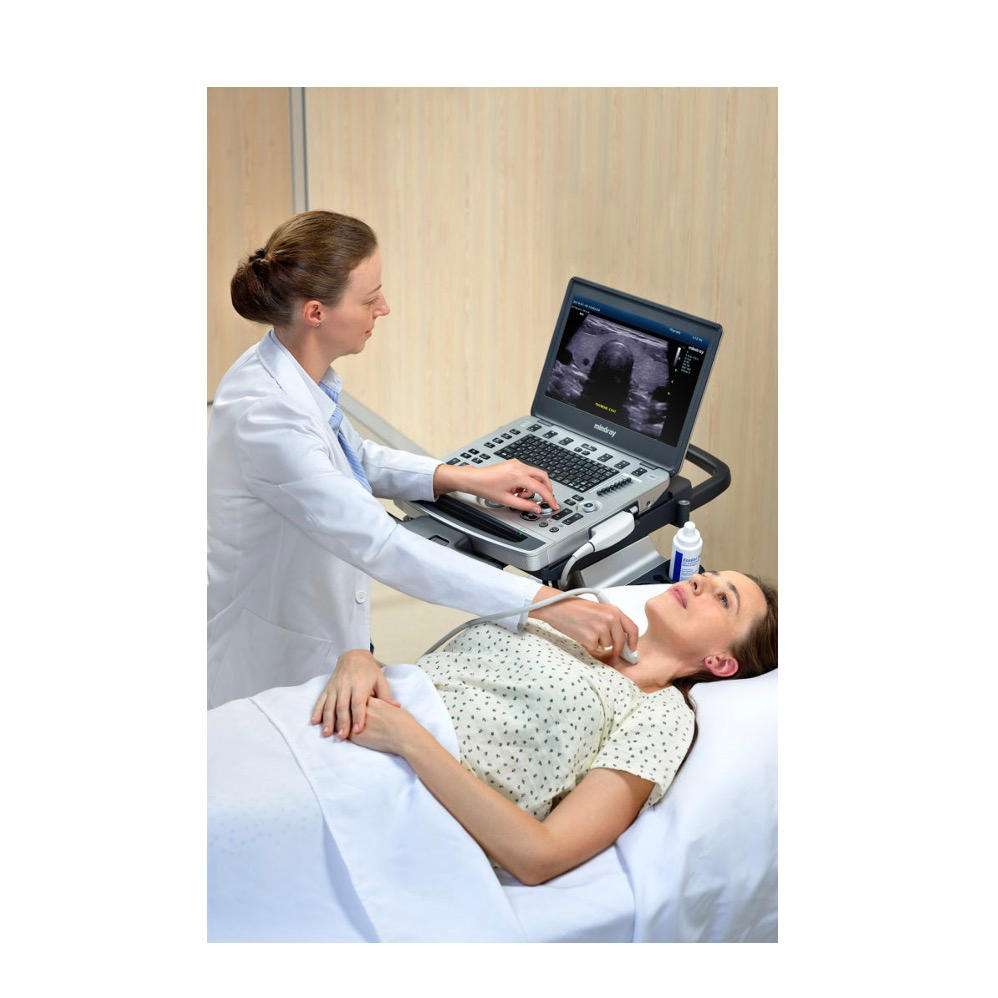
Image source: Mindray Original manufacturer image / product page · Externally linked manufacturer image; no redistribution-license claim. Served from the manufacturer’s website, not copied to AZNO. No endorsement of AZNO implied.
Eight criteria, one consistent evidence standard
Source-based editorial assessment, not hands-on imaging validation. No overall score is calculated from a partial set of known criteria. This rubric is separate from the handheld comparison.
| Criterion | Grade | Evidence and limitation |
|---|---|---|
| Weight with internal battery | NR | Manufacturer lists 12.8 lb (about 5.8 kg), also rounded to 6 kg; battery inclusion unresolved. |
| Active console battery runtime | NR | Family/legacy claims: 90 min internal, over 3 h with cart. Exact Ruby release and test conditions not fixed. |
| Attributable user image-quality evidence | NR | Positive M9 family comment and a separate mutual-TLS integration issue have unspecified Ruby status; not a numerical quality sample. |
| Technology and AI | NR | UWN+ CEUS, LVO / stress echo, tissue tracking and TEE options; regional licenses apply. |
| User friendliness | NR | Confirm the control SKU; iTouch is not proof of touchscreen hardware. |
| Probe variety | NR | Three active ports advertised; cart vs standalone configuration needs confirmation. Ruby flyer includes L14-6Hs / L20-5s / P8-3Ts. |
| Storage and export | NR | M-Secure and encrypted DICOM advertised; validate the buyer’s actual PACS workflow. |
| Normalized kit price | NR | Ruby-specific current numeric kit price unverified. Generic refurbished M9 is not a Ruby price. |
NR = not rated, never zero. Overall score: not assigned.
Brand and exact model
Mindray was founded in Shenzhen, China, in 1991. [1] Its portfolio includes patient monitoring and life support, in-vitro diagnostics and medical imaging. [2] This review covers M9 Ruby Edition. A manufacturer flyer is dated March 2019; that establishes Ruby documentation by that date, not a verified first launch date or the age of an offered unit. [3]
What you are buying
M9 Ruby Edition is a laptop-style ultrasound system currently presented by Mindray North America for point-of-care work. Its advertised options also make it relevant to a separate cardiac-focused comparison. This is a source-based buying guide; AZNO has not performed hands-on or comparative clinical testing. [4]
The purchasing question is whether the offered unit is actually the Ruby configuration, with the required hardware, software and probes. A listing headed “M9” or a shared M9/M9 Premium/M8 Elite manual does not answer that question. Ask for a configuration sheet, installed software version and serial-prefix confirmation. Do not infer Ruby status from copied marketing language or transfer specifications from another M-series model.
Documented specifications and battery limits
The current Ruby page lists a 15.6-inch LED display, 12.8 lb (approximately 5.8 kg; the manufacturer also rounds it to 6 kg) mass and three active ports. [4] Battery inclusion and standalone socket count are unclear. Ask which figures include cart hardware before comparing consoles.
An older M9 brochure dated June 2018 states 90 minutes of built-in-battery scanning and more than three hours with the cart. Mindray's current portable-ultrasound overview repeats 1.5 hours for the M9 family. Those are manufacturer claims, but neither fixes the exact Ruby battery pack, software release, probe, imaging modes or test conditions. This guide therefore records them as family-level context and leaves exact-Ruby runtime unrated. The cart figure is excluded from console endurance. [5, 6]
For a travelling kit, weigh the actual console with its installed batteries and separately weigh the complete bag, probes and charger. Run a representative scanning session before accepting a runtime commitment. An advertised family maximum is a weak substitute for this check, particularly on a used machine.
Cardiac capabilities and probe choices
Ruby documentation describes UWN+ contrast imaging, LVO/stress echo, tissue tracking and TEE options. [3, 4] The Ruby flyer names L14-6Hs, L20-5s and P8-3Ts probes. [3] Verify inclusion separately for the proposed bundle.
The manufacturer's M9 transducer sheet lists SP5-1s adult cardiac, P7-3s and P10-4s pediatric/neonatal sector probes, P7-3Ts adult TEE, P8-3Ts pediatric TEE and CW pencil probes. That sheet is dated 2018. It is useful evidence of family coverage, but a current regional compatibility matrix is still required for an exact Ruby purchase. Probe availability, supported applications and supplied probes are separate questions. [7]
AZNO's cardiac reference kit includes the console, internal battery and charger, adult phased-array probe, linear vascular probe, appropriate B/M/color/PW/CW/TDI and ECG configuration, required cardiac reporting/export licenses and written warranty. List TEE, stress, strain, contrast, cart and any additional AI packages separately unless included. Do not compare this package's price with a convex-plus-linear general-imaging kit.
Controls, storage and integration
A touchscreen has not been verified for the exact Ruby configuration in this research pass. The feature name iTouch should not be interpreted as proof of touchscreen hardware. The complete physical trackball, touchpad and touchscreen arrangement must be recorded separately before applying AZNO's control-preference component.
Mindray advertises M-Secure cybersecurity and encrypted DICOM connectivity for Ruby. That is not a verified end-to-end integration result for a particular hospital. Exact usable storage, supported export formats, installed DICOM licenses and software-specific security compatibility remain open. Ask the supplier to demonstrate the local PACS/worklist and reporting workflow using representative test data. [4]
Independent user feedback
In a January 2025 public emergency-medicine discussion, u/WhatsYourMeaning reported using Mindray M9 and TE7 and preferring M9. The comment does not identify Ruby, software, probes or a reasoned image-quality comparison. It is a first-person public account with unverified identity, retained only as family-level context. It does not support a Ruby score. [8]
An August 2026 PACS discussion reports difficulty configuring mutual TLS on an M9. The author said ordinary TLS worked and a Mindray support ticket remained open. The release and Ruby status were unspecified, and the thread does not establish a product-wide defect. Its useful implication is to test the required authentication workflow on the offered release. [9]
No independently attributable Ruby-specific numerical image-quality sample sufficient for scoring was verified. Dealer reviews, manufacturer-selected images and generic praise for Mindray are not substitutes. Absence of qualifying feedback does not establish poor performance.
Important support check for older M9 systems
Source-access limitation: the supplied review packet records the serial-specific service notice below. Its primary PDF could not be retrieved again during this import. Obtain a current written eligibility check from Mindray before relying on its dates; do not apply the notice to every M9 Ruby Edition.
Mindray North America's notice dated 21 August 2025 applies to M9 systems whose serial numbers start with 7B. It says parts support and repair-center services end by 31 December 2026, and technical support ends on 31 December 2027. New/renewed contracts cannot extend beyond 31 December 2026; existing contracts already ending later run to their stated end. [10]
The notice explicitly exempts the limited number of 7B systems with UPG software version 05.00.00 or higher, because they have an upgraded hardware platform. It must not be presented as an end-of-service notice for every M9 or every Ruby Edition. Before buying an older unit, obtain written confirmation of its serial prefix, UPG version and support eligibility. The exception and the dates are both essential. [10] Direct North American purchases have advertised five-year coverage; agent warranties can differ, and new hardware/application upgrades cost extra. [4] Obtain the actual warranty terms, especially for secondhand equipment.
Approximate price and what it covers
Price status on 14 October 2026: quotation required for a verified M9 Ruby cardiac kit. A Maven Imaging listing explicitly names Ruby Edition but the retrieved page provides no numeric sale price. Generic used/refurbished M9 listings were found, but Ruby identity and included probes were insufficiently established. Their amounts are excluded rather than used to create a misleading Ruby price range. [11, 12]
A defensible quote should state country, currency, condition, hardware/software release, probe IDs, batteries and charger, licenses, warranty, service eligibility, training, tax and shipping. On an older unit, support eligibility can change buying value as much as the initial asking price.
AZNO buying verdict
M9 Ruby Edition is a reasonable cardiac-capable portable shortlist entry when its documented options fit the intended examinations. The next decisive evidence is an exact configuration and support statement, followed by a representative demonstration. The review remains on hold for an exact-kit recommendation; an older generic M9 price or runtime claim cannot close those gaps.
Comparison at a glance
| Item | Source-backed finding / limit |
|---|---|
| Clinical lane | Cardiac / POCUS |
| Approximate price / quote | Quote required — exact kit price unverified |
| Package / price scope | Ruby-specific current numeric kit price unverified. Generic refurbished M9 is not a Ruby price. |
| Weight | Manufacturer lists 12.8 lb (about 5.8 kg), also rounded to 6 kg; battery inclusion unresolved. |
| Internal battery / cart distinction | Family/legacy claims: 90 min internal, over 3 h with cart. Exact Ruby release and test conditions not fixed. |
| Display | 15.6-inch LED |
| Controls | Confirm the control SKU; iTouch is not proof of touchscreen hardware. |
| Probe connectivity | Three active ports advertised; cart vs standalone configuration needs confirmation. Ruby flyer includes L14-6Hs / L20-5s / P8-3Ts. |
| Technology / software | UWN+ CEUS, LVO / stress echo, tissue tracking and TEE options; regional licenses apply. |
| Storage / export | M-Secure and encrypted DICOM advertised; validate the buyer’s actual PACS workflow. |
| User evidence | Positive M9 family comment and a separate mutual-TLS integration issue have unspecified Ruby status; not a numerical quality sample. |
Price evidence is dated October 14, 2026 and can change. These are seller references or quote statuses, not AZNO stock, selling prices or a hands-on clinical ranking.
Sources and further reading
- Mindray company history
- Mindray manufacturer overview in MindFocus
- Mindray Ruby Edition flyer, March 2019, 0002-08-40392 Rev A
- Mindray North America current M9 Ruby Edition page
- Mindray M9 system brochure, June 2018, 0002-08-40304 Rev B; family-level/legacy evidence
- Mindray current portable-system overview; M9 family battery claim
- Mindray M9 transducer family sheet, May 2018, 0002-08-40353 Rev A
- Public M9 family-level user comment, 16 January 2025
- Public M9 integration account, 28-31 August 2026, Ruby status unspecified
- Mindray North America service notice, 21 August 2025; includes UPG 05.00.00-or-higher exception
- Maven Imaging Ruby Edition listing, no numeric price retrieved
- Absolute Medical/DOTmed generic refurbished M9 listing; excluded from Ruby pricing
Use current manufacturer instructions and qualified technical advice for your exact equipment. This article does not establish clinical suitability, guaranteed repair results or an AZNO offer.